Outdated WHOIS: When a Lookup Misses the New Owner
Published 2026-11-04 · By Aaron Kempf
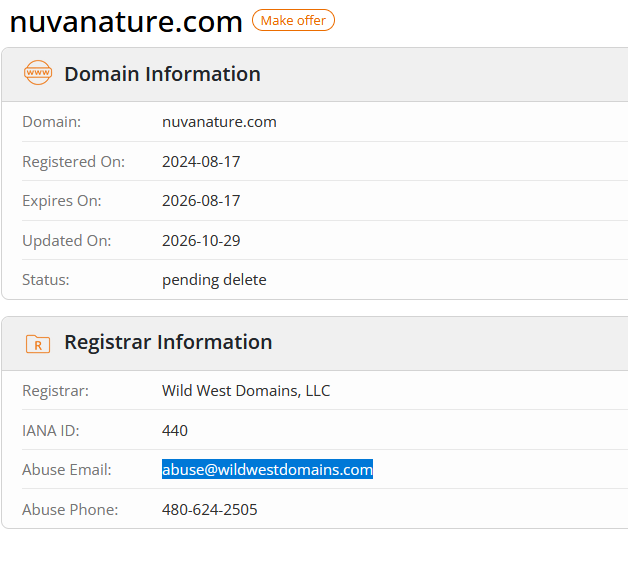
On 4 November 2026 we looked up nuvanature.com on one of the best-known WHOIS websites. It said the name was pending delete, still with its old registrar, last updated on 29 October. The registry said something different: the name had been registered again that morning by a new registrar. Outdated WHOIS answers like this are common, and they matter most at exactly the moment you care about a name.
What the two lookups said
Here is what each source returned, a few seconds apart on the same day.
| Popular WHOIS website | Registry (RDAP), via Quick Lookup | |
|---|---|---|
| Status | pending delete | active |
| Registrar | Wild West Domains, LLC | SnapNames 62, LLC |
| Registered | 2024-08-17 | 2026-11-04 |
| Expires | 2026-08-17 | 2027-11-04 |
| Nameservers | (not shown) | ns1.afternic.com, ns2.afternic.com |
The first column describes a domain that was about to be deleted. The second describes a domain that was deleted, caught and re-registered, and is now parked on a marketplace's nameservers. Only one of those can be true today, and the registry is the source of truth for .com.
Why WHOIS pages go stale
Most WHOIS websites don't ask the registry every time someone visits. They store a copy of the record and show that copy until it's refreshed. That's reasonable for most names, because most domains change hands rarely. A record that's a week old is usually still right.
It fails for names in the middle of a change. The end of a domain's life moves fast:
- The owner doesn't renew, and the name passes its expiry date.
- After a grace period, the registrar deletes it and the registry marks it pending delete for about five days.
- On the day it drops, drop-catch services race to register it the instant it's released.
SnapNames is one of those drop-catch services. When a name is caught, the new registration often lands within seconds of the drop. A WHOIS page that cached the record during step 2 will keep showing "pending delete" until its next refresh, even though the name already has a new owner.
How Quick Lookup avoids outdated WHOIS data
Quick Lookup on DNSLister checks each name three separate ways and shows the answers side by side:
- DNS: does the name resolve right now?
- Registry (RDAP): what does the registry itself say? This is the modern, structured replacement for WHOIS, and for .com the answer comes from Verisign, which runs the .com registry.
- WHOIS: the traditional text record, shown separately so you can compare.
Answers are kept for a few minutes at most, so a repeat lookup doesn't hit the registry twice in a row. They're never kept for days. If the three layers disagree, you see the disagreement instead of a single answer that hides it. Disagreement is often the most useful thing a lookup can tell you, because it means the name is in the middle of a change.
What this means if you're watching a dropping name
If you're waiting for a name to drop, an outdated record can cost you the name or send you chasing one that's already gone:
- Don't trust "pending delete" from a cached page. Check the registry on the day the name is due to drop.
- Look at the nameservers. A newly registered name parked on a marketplace's nameservers has usually been caught and listed for resale.
- Check the registration date. A creation date of today means someone registered it today, whatever the status line elsewhere says.
- Look at more than one layer. DNS, RDAP and WHOIS each have their own delays. When they agree, you can trust the answer.
How to check a name yourself
Type the domain into Quick Lookup. Read the RDAP panel first: it shows the registrar, the registration and expiry dates, the status and the nameservers, straight from the registry. If you want the raw record, open it under the panel. If you're checking a whole list of names, Bulk Domain Check runs the same live checks in one go.
For more on the difference between the two protocols, see WHOIS vs RDAP.
Related reading
- Domain Availability Checker: What a Green Result Means
- We Now Support .si Domains, and Why an “Available” 3-Letter .si Probably Isn't
Frequently asked questions
Is WHOIS data wrong?
Usually not wrong, just old. The registry's own record is current; a copy stored by a website is only as fresh as its last refresh.
How long does pending delete last?
For .com and .net, about five days. After that the registry releases the name, and it can be registered again immediately.
Can I see who caught a dropped name?
You can see the registrar. Drop-catch services register through their own registrar accounts, so a registrar name like SnapNames, with marketplace nameservers, usually means the name was caught for resale.